What Is Cloud Computing?
By the end of this lesson, you'll be able to:
- Explain what cloud computing means in terms of renting infrastructure as a service
- Contrast traditional, self-owned infrastructure with cloud infrastructure using a concrete scenario
- Identify at least three practical benefits cloud computing gives a growing software team
Prerequisites: None — this is the first lesson in the course.
Renting instead of owning
Every application needs somewhere to actually run — a computer to execute the code, a disk to store data, and a network connection so people can reach it. Traditionally, a company bought that computer, put it in a room (or paid someone else to), kept it powered and cooled, and had someone on staff to fix it when a disk failed at 2am.
Cloud computing replaces "buy and run it yourself" with "rent it, already running, from someone who operates thousands of these at once." A provider like AWS owns the physical data centres, hardware, power, and cooling, and rents out slices of that capacity over the internet. You never see or touch the physical machine — you just use it, and pay for what you actually use.
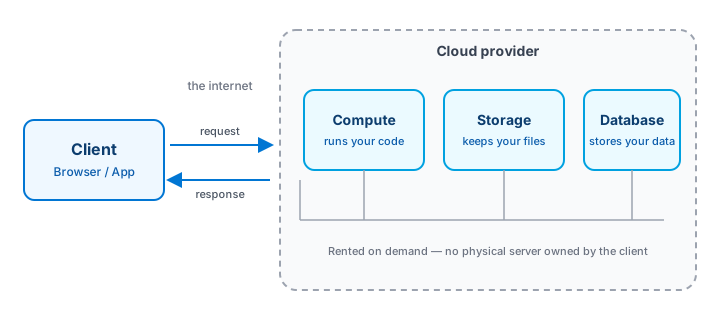
The three boxes inside the cloud in the diagram above — compute, storage, and database — are exactly the AWS service categories the next lesson introduces.
A concrete before-and-after
Picture Karoo Retail, a small South African online store. Every year, they run a two-week sale where traffic jumps to ten times its normal level, then drops back to normal for the other fifty weeks.
The traditional approach: buy enough physical servers to survive the sale at peak load. Those same servers then sit mostly idle for the other fifty weeks — Karoo Retail paid for capacity it uses two weeks a year, and if the sale ever grows faster than expected, there's no way to get more capacity except ordering more hardware and waiting for it to arrive.
The cloud approach: Karoo Retail rents only the capacity it needs, when it needs it. In the two weeks before the sale, they request more capacity — it's available in minutes, not weeks — and afterwards they release it and stop paying for it. The infrastructure decision that used to take months of procurement becomes something closer to an on/off switch.
What actually changes — and what doesn't
Cloud computing doesn't make good engineering optional. Karoo Retail's application still has to be built in a way that can actually take advantage of extra capacity when it's added — that's a real skill, and later modules in this course spend real time on it (scaling, load balancing, fault tolerance).
What changes is the shape of the decision:
- Cost moves from a large upfront purchase (capital expenditure) to an ongoing, usage-based bill (operating expenditure).
- "We need more capacity" becomes a request you can make and reverse in minutes, not a hardware order with a lead time.
- Physical maintenance — replacing failed disks, patching the operating system, network upkeep — is not something the customer does for the underlying hardware.
Why this matters in practice
Put together, this gives a growing team a few real, practical advantages:
- Elasticity — capacity can grow or shrink to match actual demand, instead of being sized for a worst case that mostly never happens.
- Pay-as-you-go economics — you're billed for what you use, not for headroom sitting idle.
- Speed — new capacity is available in minutes, not the weeks a hardware order takes.
- Global reach — the same application can run closer to customers in different parts of the world without a company building its own data centre in each one.
None of these are free of trade-offs — later lessons in this module cover pricing and responsibility in more depth — but together they explain why cloud computing has become the default starting point for most new software projects.
Exercise
Karoo Retail's traffic triples for two weeks a year and is otherwise ordinary. Based on what this lesson covered, write 2–3 sentences explaining whether buying enough physical servers to handle sale-level traffic year-round makes sense, or whether renting cloud capacity is the better fit — and why.
Show hint
Think about what happens to that extra hardware capacity for the other fifty weeks of the year, and who pays for it either way.
What Is Cloud Computing? Quiz
My Notes
Log in to keep private notes on this lesson.
Questions about this lesson
No questions yet — be the first to ask.
Log in to ask a question about this lesson.
Summary
Cloud computing means renting compute, storage, and networking from a provider instead of buying and running physical servers yourself — trading upfront capital cost and hands-on maintenance for an on-demand, pay-as-you-go model.