AWS Global Infrastructure: Regions, Availability Zones, and Edge Locations
By the end of this lesson, you'll be able to:
- Distinguish between an AWS Region, an Availability Zone, and an edge location
- Explain why Region and Availability Zone are not interchangeable terms
- Given a scenario, reason about which infrastructure concept — latency, resiliency, or compliance — is most relevant
Prerequisites: "Introduction to AWS"
Regions: independent geographic areas
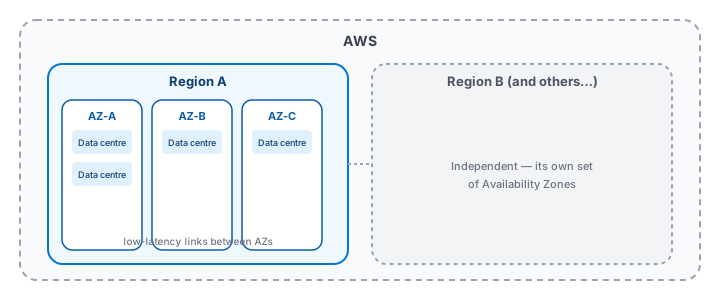
An AWS Region is a specific geographic area — for example, one Region located in Africa, another in Europe, another in North America. Each Region operates independently of the others, with its own separate infrastructure.
Choosing a Region isn't a minor detail. It affects how far network traffic has to travel to reach your users (latency), and it can affect legal or regulatory obligations about where certain data is allowed to be stored — organisations should evaluate their own applicable regulatory and data-residency requirements before treating a Region choice as final.
Availability Zones: resilience within a Region
Within a single Region, AWS operates multiple Availability Zones (AZs) — physically separate data centre clusters with their own independent power, cooling, and networking, but connected to each other by fast, low-latency links.
This is the distinction worth remembering: a Region contains multiple Availability Zones — a Region is not an Availability Zone, and an Availability Zone is not a Region. Spreading a system's resources across more than one AZ inside the same Region means that if one AZ has a problem — a power failure, for instance — the others keep running and your application can keep working.
Edge locations: getting content closer to users
Edge locations are smaller AWS sites, far more numerous than full Regions, used mainly to cache and deliver content closer to end users — reducing the distance data has to travel for things like images, videos, and static website assets. You'll see this in practice with Amazon CloudFront in Module 4. For now, the key idea is: an edge location isn't a place your application "runs" the way a Region is — it's a place your content gets cached closer to whoever's requesting it.
Why the distinction actually matters
Three examples make this concrete:
- Latency — a South African company with almost all its customers in Southern Africa should pick a Region physically close to them, not one on another continent, to keep response times low.
- Resiliency — a company that wants its application to survive a single data centre failure should spread its resources across multiple Availability Zones within one Region — picking a "better" Region alone doesn't achieve this on its own.
- Compliance and data residency — a company handling data with legal residency requirements needs to evaluate which Region(s) satisfy those requirements; this is a Region-level decision, not an Availability Zone-level one.
Two more factors worth knowing about: not every AWS service is available in every Region, and prices can differ by Region — both are reasons to treat "which Region?" as a real decision rather than a default.
Exercise
Karoo Retail's customers are almost entirely inside South Africa, and the company has been told their invoicing data may have data-residency obligations they haven't yet confirmed. List two AWS Region considerations Karoo Retail should evaluate before finalizing where to run their application, and briefly explain why each matters.
Show hint
One consideration is about where their customers physically are; the other is about a legal/regulatory question this lesson deliberately does not answer for you.
AWS Global Infrastructure: Regions, Availability Zones, and Edge Locations Quiz
My Notes
Log in to keep private notes on this lesson.
Questions about this lesson
No questions yet — be the first to ask.
Log in to ask a question about this lesson.
Summary
AWS's physical infrastructure is organized into Regions (independent geographic areas), Availability Zones (isolated data centre clusters within a Region), and edge locations (points of presence closer to end users) — and mixing up a Region with an Availability Zone leads to real mistakes in resiliency and compliance planning.