The Shared Responsibility Model
By the end of this lesson, you'll be able to:
- Explain the difference between security "of" the cloud and security "in" the cloud
- Give at least three concrete examples that illustrate where the responsibility line falls
- Identify basic security habits worth adopting from day one, regardless of which AWS services are used
Prerequisites: "AWS Free Tier and Pricing Basics"
Two sides of one responsibility
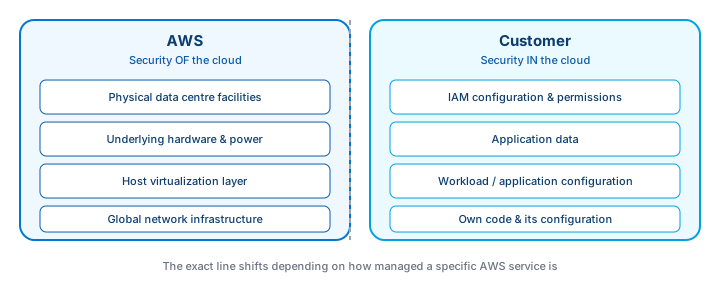
AWS describes this split as security "of" the cloud versus security "in" the cloud.
- AWS's responsibility ("of" the cloud): the physical data centres, the underlying hardware, the host virtualization layer, and the global network infrastructure that everything else runs on.
- The customer's responsibility ("in" the cloud): how you configure the services you use, who inside your organisation can access or change them, the data you put into them, and your own application code and its configuration.
Three concrete examples
- Physical data centre security — deciding who can physically walk into a building and touch a server is entirely AWS's job. No customer, no matter what they use, manages this themselves.
- IAM permissions inside a customer's account — deciding which employees can create, modify, or delete cloud resources is entirely the customer's job. AWS provides the IAM service itself, but doesn't decide an individual company's permission structure for it.
- Data stored inside a customer's own database or storage service — the content itself, and choices like whether it's encrypted or who it's shared with, are the customer's responsibility, even though the storage service runs on infrastructure AWS operates.
The line moves depending on the service
It would be an oversimplification to say the split is always the same 50/50 line. The more AWS manages a service for you, the more of the day-to-day operational burden shifts to AWS. For example, a fully managed database service takes on patching the underlying database engine itself, while a more "raw" virtual server leaves the customer managing more of that software stack directly.
Think of it as a sliding scale rather than a fixed rule — later modules point out exactly where that line sits for each specific service as they're introduced.
Security habits to build starting today
None of this requires deep IAM knowledge yet — that's the whole subject of Module 2 — but a few principles apply from day one regardless:
- Protect the root user specifically (covered last lesson) and treat MFA on it as non-negotiable.
- Don't casually create or share access keys — they're credentials, not conveniences.
- Never commit AWS credentials of any kind into a Git repository, even a private one. A key committed to source control should be treated as compromised the moment it's pushed.
- Remember the Shared Responsibility Model itself: AWS securing its infrastructure doesn't protect you from a permission mistake or an exposed credential on your side of the line.
Exercise
For each of the following, decide whether it's primarily AWS's responsibility or the customer's responsibility under the Shared Responsibility Model, and briefly say why: (1) replacing a failed hard drive inside an AWS data centre, (2) deciding which employees can delete a company's cloud resources, (3) encrypting a sensitive customer document before it's uploaded to cloud storage.
Show hint
Ask whether the task is about the physical infrastructure itself, or about a choice the customer makes about their own account or data.
The Shared Responsibility Model Quiz
My Notes
Log in to keep private notes on this lesson.
Questions about this lesson
No questions yet — be the first to ask.
Log in to ask a question about this lesson.
Summary
The Shared Responsibility Model splits security duties between AWS, which secures the underlying cloud infrastructure, and the customer, who is responsible for what they configure and put into that infrastructure — and exactly where that line falls shifts depending on which AWS service is being used.