The Principle of Least Privilege
By the end of this lesson, you'll be able to:
- Explain the principle of least privilege in one sentence
- Identify over-permissioned access in a realistic scenario and explain what is wrong with it
- Design a narrowly-scoped permission set for a specific, described task
Prerequisites: "IAM Roles and Policies"
The principle, stated plainly
Least privilege: grant only the permissions a task actually needs, and nothing more.
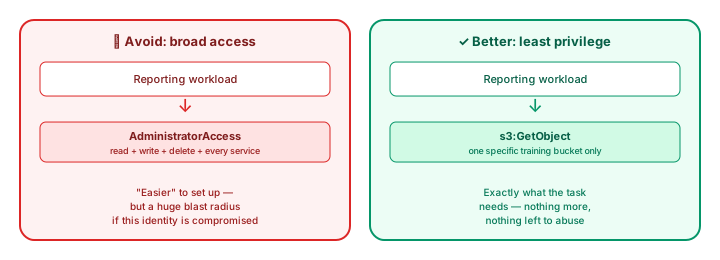
It sounds obvious once stated, but the tempting alternative shows up constantly in real teams: "just give the developer AdministratorAccess, it's easier than figuring out exactly what they need." That single sentence is the principle of least privilege being abandoned for convenience — and it's worth understanding exactly what it costs.
A worked scenario
Consider a reporting process whose entire job is to read objects from one specific S3 bucket every night and generate a summary.
That process needs exactly one thing: read access to that one bucket. Under least privilege, it should not also receive:
- Write or delete access to that bucket, or any other bucket — it never writes or deletes anything.
- EC2 permissions — it doesn't touch servers.
- IAM administration permissions — it certainly doesn't need to create or modify other identities.
Every one of those extra permissions would do nothing to help the reporting process do its actual job. What they would do is widen the damage possible if that process's credentials were ever compromised — an attacker who compromises a read-only identity can only read; an attacker who compromises an over-permissioned identity inherits everything it was needlessly given.
Why "easier" is a false economy
Granting broad access up front feels faster in the moment — no need to figure out the exact list of actions a task requires. But that convenience is borrowed against future risk: every identity with more access than it needs is a larger target, and a larger potential loss, for exactly zero ongoing benefit. Figuring out the narrow, correct permission set once, up front, is cheaper than the alternative in every case that actually matters.
This is also why the previous lesson's dangerous "Action: , Resource: " example is worth remembering here specifically — it's the least-privilege violation taken to its logical extreme.
Exercise
A nightly reporting process only needs to read objects from one specific S3 bucket. List every permission it should NOT receive under least privilege, and explain briefly why each one would violate the principle even if it "might be useful someday."
Show hint
Consider write access, delete access, permissions for entirely different services, and IAM administration permissions.
The Principle of Least Privilege Quiz
My Notes
Log in to keep private notes on this lesson.
Questions about this lesson
No questions yet — be the first to ask.
Log in to ask a question about this lesson.
Summary
The principle of least privilege means granting an identity only the specific permissions its task actually requires — nothing broader "to be safe" or "to save time" — because every unnecessary permission is a risk that provides no corresponding benefit.