Stacks, Parameters, and Outputs
By the end of this lesson, you'll be able to:
- Explain how a Parameter makes a template reusable without editing every resource definition
- Read a template that uses a Parameter to configure a Resource, and an Output to expose a value from it
- Explain why Outputs must never expose secrets, and what belongs there instead
Prerequisites: "AWS CloudFormation Templates"
Parameters: reusing one template for different deployments
A Parameter is a deployment-time input to a template — a value supplied when the stack is created or updated, rather than hardcoded into the template itself. A simple, fictional example:
Parameters:
  EnvironmentName:
    Type: String
    Default: training
This lets the same template be deployed more than once with a different EnvironmentName value each time — a genuine, common need this course has run into repeatedly (Module 5's discussion of reusable table designs, Module 9's discussion of one image running as many independent containers). Good uses for a parameter: an environment name, a non-secret configuration choice, a deployment-specific setting. A parameter should never be a plain-text secret — that's exactly the anti-pattern Module 10 already warned against for environment variables generally, and it applies here without exception.
Resources: using the parameter
Resources:
  TrainingQueue:
    Type: AWS::SQS::Queue
This fictional TrainingQueue resource builds directly on Module 8's SQS lesson — the same managed queue concept, now expressed as a template resource instead of something clicked into existence by hand. A real template would typically reference the EnvironmentName parameter somewhere in this resource's configuration (for example, as part of a name), so the deployed queue reflects which environment it belongs to.
Outputs: exposing useful values — never secrets
Outputs:
  QueueUrl:
    Value: !Ref TrainingQueue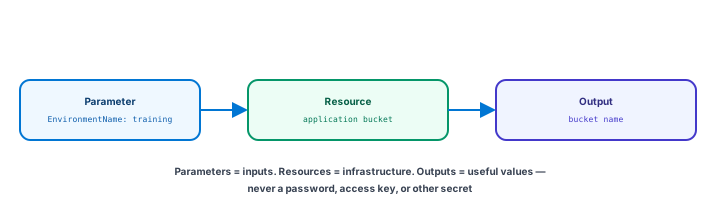
An Output exposes a value produced by the stack — here, the URL of the fictional queue it created — so other templates, tools, or people can retrieve it without having to look it up manually. This is worth stating as directly as Module 10 stated it for logs: an Output must never expose a password, access key, token, or any other secret value. A stack's outputs are plainly visible information about the deployment, not a protected place to stash something sensitive.
Exercise
For each of the following, classify it as a Parameter, a Resource, or an Output: (1) "EnvironmentName, defaulting to training", (2) "an SQS queue named TrainingQueue", (3) "the queue's URL, exposed after deployment." Then explain why a database password should never appear as a template Output, even though it might seem convenient to retrieve it that way.
Show hint
Match each item to whether it's a deployment-time input, the actual infrastructure, or a value exposed afterward. The password question connects directly to Module 10's secrets-handling guidance.
Stacks, Parameters, and Outputs Quiz
My Notes
Log in to keep private notes on this lesson.
Questions about this lesson
No questions yet — be the first to ask.
Log in to ask a question about this lesson.
Summary
A Parameter supplies a deployment-time input so the same template can be reused across environments without editing its Resources, and an Output exposes a useful value produced by a deployed resource — but an Output must never expose a password, access key, or other secret, since it's a plainly visible part of the stack's information.