Building the API Layer: API Gateway and Lambda
By the end of this lesson, you'll be able to:
- Describe the synchronous request path from a client through API Gateway and Lambda to DynamoDB
- Justify moving certificate generation onto an asynchronous, queue-based path instead of the synchronous request path
- Explain why an async worker needs to be idempotent, and what a dead-letter queue is for
Prerequisites: "Designing the Frontend: S3 and CloudFront"
The synchronous path: API Gateway, Lambda, DynamoDB
Most of what this application's API needs to do is straightforwardly synchronous: a learner's browser asks for a lesson's content, or reports that a lesson was completed, and expects a response before moving on. This is exactly what Module 7's API Gateway plus Lambda pattern is for: API Gateway receives the HTTP request and invokes a Lambda function, which does the actual work — reading or writing DynamoDB — and returns a response.
Requirement: handle learner-facing API requests (view a lesson, record progress) without operating always-on servers sized for peak load. Decision: API Gateway routes requests to Lambda functions that read and write DynamoDB. Reason: this combination scales automatically with request volume and has no idle server cost between requests. Alternative: a container-based API (Module 9's ECS/Fargate pattern) running continuously behind a load balancer. Trade-off: Lambda functions have per-invocation constraints (timeout, cold starts) that a long-running container doesn't — reasonable here because these requests are short, but worth stating rather than ignoring.
Certificate generation: why it moves off the request path
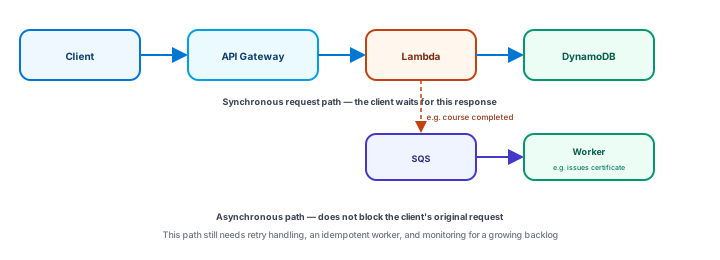
This is the module's worked capstone example of asynchronous processing, first introduced in Lesson 1's Project Decision Record: when a learner completes a course, a certificate should be generated (and possibly emailed), but that work — rendering a document, calling an email provider — is slower and not something the learner's "course complete" response should wait on.
Requirement: certificate generation must not block or slow down the learner's course-completion request. Decision: the completion Lambda sends a message to an SQS queue; a separate worker consumes it and generates the certificate. Reason: this decouples a slow, non-critical background task from the fast request/response path the learner is actually waiting on (Module 8's decoupling pattern). Alternative: generate the certificate synchronously inside the same Lambda invocation before responding. Trade-off: the async path is eventually consistent (the certificate isn't ready the instant the response returns) and introduces new failure modes — a message could be processed twice, or a worker could fail — that the synchronous alternative doesn't have.
Making the async path trustworthy: idempotency and dead-letter queues
Moving work onto a queue doesn't remove the responsibility to handle failure — it changes where that responsibility lives. Two concerns matter specifically for this worker:
Idempotency: SQS can, under some conditions, deliver a message more than once. If the worker isn't written to handle that safely — for example, by checking whether a certificate for this learner and course has already been issued before generating another — a retried message could produce a duplicate certificate. An idempotent worker produces the same end result whether it processes a given message once or more than once.
Dead-letter queues: if a message repeatedly fails processing (a malformed record, a downstream error that never clears), it shouldn't retry forever or simply vanish. A dead-letter queue captures messages that failed past a configured retry limit, so they can be investigated instead of silently lost — and a growing dead-letter queue is exactly the kind of thing Lesson 6's monitoring should alert on.
Exercise
Explain, in your own words, what could go wrong if the certificate-generation worker were written without idempotency — that is, if processing the same message twice always generated a brand-new certificate. Then describe one concrete way the worker could check whether a certificate has already been issued before generating another.
Show hint
Think about what SQS's at-least-once delivery guarantee actually implies for a worker that isn't written defensively.
Building the API Layer: API Gateway and Lambda Quiz
My Notes
Log in to keep private notes on this lesson.
Questions about this lesson
No questions yet — be the first to ask.
Log in to ask a question about this lesson.
Summary
API Gateway and Lambda handle the application's synchronous request/response traffic — reading a lesson, saving progress — while at least one background scenario, certificate generation on course completion, is deliberately moved onto an SQS-based asynchronous path so a slower, non-critical task never blocks the learner's request, at the cost of needing retries, idempotency, and backlog monitoring on that path.