Relational vs. NoSQL: Choosing the Right Database
By the end of this lesson, you'll be able to:
- Compare the relational and NoSQL data models covered earlier in this module, side by side
- Choose an appropriate database family for a described workload, based on its access pattern
- Explain why the comparison is about fit, not about one family being universally superior
Prerequisites: "Amazon Aurora"
Bringing the two families together
This module has now covered both families this course focuses on: relational (RDS and Aurora, built around tables, relationships, and SQL) and NoSQL (DynamoDB, built around items grouped by a partition key). Neither is a replacement for the other — they solve different shapes of problem.
Side by side
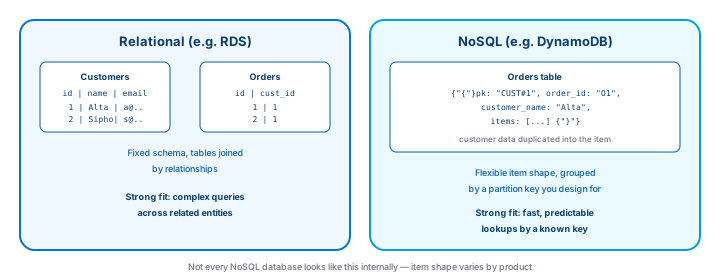
- Relational (RDS / Aurora) — fixed schema, relationships enforced between tables, flexible querying across those relationships via SQL. Strong fit: structured data with genuine relationships and reporting/query needs that aren't fully known upfront.
- NoSQL (DynamoDB) — flexible item shape, organized around a partition key chosen for a known access pattern. Strong fit: high-volume, predictable lookups by a known key, where the access pattern is understood in advance.
Working through two scenarios
- Karoo Retail's customer and order reporting (from Lesson 2) — orders belong to customers, and reporting needs to join across both, sometimes in ways not fully known upfront. This points toward relational.
- The device-monitoring event log (from Lesson 3) — a very high volume of independent events, looked up almost always by a known device ID. This points toward NoSQL.
Neither scenario makes the other database family "wrong" in general — each one is simply a poor fit for the other scenario's access pattern.
The decision question, distilled
When choosing between them for a real workload, the load-bearing question is: do you need flexible querying across relationships that aren't fully known in advance (lean relational), or do you have a known, dominant access pattern you can look up by a key quickly (lean NoSQL)? This isn't a permanent, irreversible choice for every application forever — some real systems use both, for different parts of their data — but it's the right first question to ask, rather than defaulting to whichever service is more familiar.
Exercise
A ticket-booking system needs to: (a) enforce that a booking belongs to exactly one customer and one event, and support ad-hoc reporting queries the business hasn't fully defined yet, while a separate part of the same company needs to (b) store and instantly retrieve a user's current session state by session ID, at very high volume. Which database family fits each part, and why?
Show hint
One part needs relationships and flexible querying; the other needs one clear key and speed.
Relational vs. NoSQL: Choosing the Right Database Quiz
My Notes
Log in to keep private notes on this lesson.
Questions about this lesson
No questions yet — be the first to ask.
Log in to ask a question about this lesson.
Summary
Relational databases (RDS, Aurora) suit structured data with meaningful relationships and flexible querying needs, while DynamoDB suits workloads dominated by fast, predictable lookups by a known key — the right choice comes from the workload's actual access pattern, not from one family being generally better than the other.