DNS and Amazon Route 53
By the end of this lesson, you'll be able to:
- Explain what DNS does in plain terms
- Describe what a hosted zone and a record represent, at a beginner level
- Explain how Route 53 resolves a domain name to an AWS endpoint
Prerequisites: "Security Groups vs. Network ACLs"
DNS, in plain terms
DNS (Domain Name System) exists to solve one problem: humans want to type a memorable name like app.example.com, but the network actually needs an address to route traffic to. DNS is the lookup that translates the first into the second.
Amazon Route 53: AWS's DNS service
Amazon Route 53 is AWS's DNS service. At a beginner level, two ideas matter:
- A hosted zone represents a domain (or subdomain) whose DNS records Route 53 manages for you.
- A record inside that hosted zone maps a specific name (like the fictional
app.example.com) to a specific target — commonly an AWS resource such as a load balancer.
Resolving a name to an endpoint
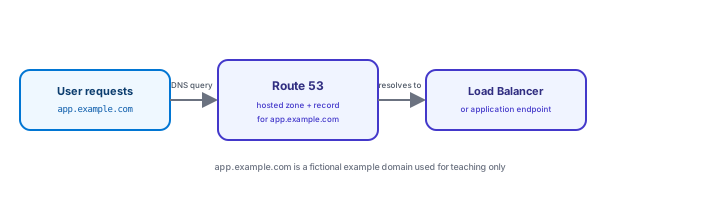
Put together with the previous lessons: a user requests a domain name, Route 53 resolves it to the address of, say, the load balancer the next lesson covers — which then distributes the request across the public subnets and application targets already introduced earlier in this module. This lesson deliberately stays at that conceptual level rather than becoming a full DNS-administration course — record types, TTLs, and routing policies beyond this beginner scope are left for later, deeper study if needed.
Exercise
Explain, in your own words, what problem DNS solves, using the fictional domain app.example.com as your example. Then describe what a Route 53 hosted zone and a record each represent, at the beginner level this lesson covered.
Show hint
DNS solves the gap between a name a human wants to type and the address the network actually needs.
DNS and Amazon Route 53 Quiz
My Notes
Log in to keep private notes on this lesson.
Questions about this lesson
No questions yet — be the first to ask.
Log in to ask a question about this lesson.
Summary
DNS translates a human-readable domain name into the address of the resource actually serving it, and Amazon Route 53 is AWS's DNS service, using a hosted zone and its records to resolve a name like a fictional app.example.com to an AWS endpoint such as a load balancer.