Why Application Integration Matters: Decoupling Systems
By the end of this lesson, you'll be able to:
- Explain why independent application components need a reliable way to communicate
- Distinguish tight coupling from decoupling using a concrete example
- Explain that decoupling is a trade-off, not an automatic improvement
Prerequisites: Module 7: "Project: Build a Serverless REST API"
Why this module exists
Module 7 showed how a single request or event reaches Lambda and runs application logic. Real applications are rarely just one function, though — they're built from multiple independent components (services, functions, workers) that each do one job, and need to work together. Application integration is the practice of connecting those independent components reliably, without forcing them to depend on each other being available at the exact same moment.
Tight coupling: a direct dependency
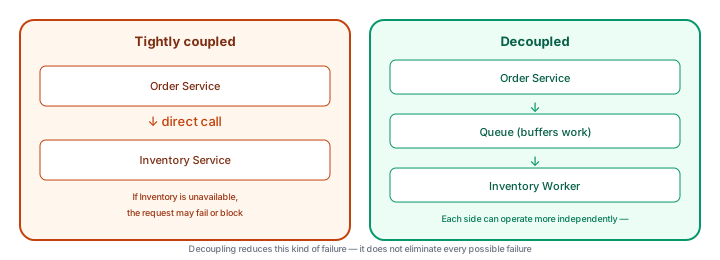
Consider an Order Service that, after creating an order, calls an Inventory Service directly to reserve stock. This is tight coupling: the Order Service's request depends on the Inventory Service being reachable and responsive right now. If Inventory is slow, overloaded, or temporarily down, the Order Service's request can fail or block — even though the order itself was otherwise valid.
Decoupling: communicating through intermediary infrastructure
A decoupled design has the Order Service hand off work to intermediary infrastructure — a queue, in the diagram above — instead of calling Inventory directly. An Inventory Worker consumes from that queue on its own schedule. Neither side needs the other to be available at the exact same instant: the Order Service can keep accepting orders even if Inventory processing is temporarily slow or briefly unavailable, because the work waits safely in between.
This module covers three AWS services built for exactly this kind of decoupled communication: Amazon SQS (queues), Amazon SNS (publish/subscribe), and Amazon EventBridge (event routing) — each solving a related but distinct shape of the same underlying problem.
Decoupling is a trade-off, not a free upgrade
It would be a mistake to treat decoupling as strictly better in every case. Introducing a queue or an event bus between two components adds real complexity: the work now happens at a slightly later, less predictable time (Module 7's synchronous-versus-asynchronous distinction applies directly here), and the system now needs to handle retries, possible duplicate processing, and monitoring for stuck or failed work — none of which a direct, tightly coupled call has to think about. The right choice depends on the actual requirement: does the caller need an immediate result, or can the work genuinely happen a little later? This module teaches the tools; the judgment about when to reach for them is the actual skill.
Exercise
An Order Service currently calls an Inventory Service directly and the whole order fails whenever Inventory is briefly overloaded during a sale. Using this lesson's distinction, explain how introducing a queue between the two services would change this specific failure mode — and name one new kind of complexity that decoupling would introduce that the direct call didn't have.
Show hint
The queue absorbs the burst of orders; the new complexity is about what happens if the Inventory Worker fails partway through processing one.
Why Application Integration Matters: Decoupling Systems Quiz
My Notes
Log in to keep private notes on this lesson.
Questions about this lesson
No questions yet — be the first to ask.
Log in to ask a question about this lesson.
Summary
As an application grows into several independent components, those components need a reliable way to communicate without depending on each other being available at the exact same moment — this is what application integration solves, and the core distinction this module builds on is tight coupling (a direct call that can fail or block) versus decoupling (communication through intermediary infrastructure that buffers work between the two sides).