Amazon EventBridge and Event-Driven Systems
By the end of this lesson, you'll be able to:
- Explain the event bus, rule, and target shape EventBridge is built around
- Distinguish EventBridge's content-based routing from SNS's subscription-based fan-out
- Trace a fictional event from a producer through a rule to a target
Prerequisites: "Amazon SNS: Pub/Sub Messaging"
EventBridge: an event bus with content-based routing
Module 7 introduced Amazon EventBridge briefly as an event bus. This lesson goes deeper into its shape: a producer (an AWS service or your own application) publishes an event to the event bus. A rule defines a pattern to match against incoming events — for example, matching only events with a specific detail-type, such as a fictional OrderCreated. When an event matches a rule, EventBridge routes it to that rule's configured target — commonly a Lambda function or an SQS queue.
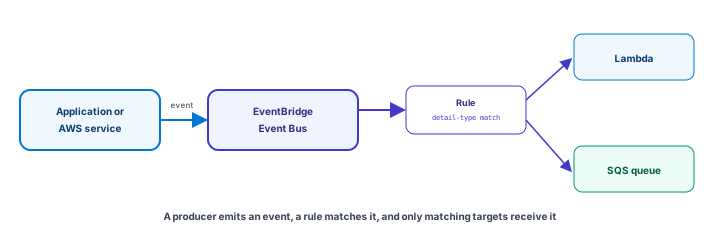
A fictional example event, kept deliberately free of any sensitive data: a rule matching detail-type: "OrderCreated" might route to a Lambda function that starts fulfillment, while a separate rule matching the same event type could route the same event to an entirely different target — both without the producer knowing or caring which rules exist.
EventBridge versus SNS: routing versus subscription fan-out
It would be an oversimplification to describe EventBridge as just "a more advanced SNS." The two have real overlap, but a different center of gravity:
- SNS focuses on publish/subscribe delivery — a publisher sends to a topic, and every current subscriber of that topic receives it.
- EventBridge focuses on routing events using content-based rules — a single event bus can have many different rules, each matching a different pattern within the event's own content, sending different matching events to different targets.
In practice, both can achieve fan-out-like results, and the right choice depends on the actual requirement: if the need is "distribute this to a fixed set of subscribers," SNS is a natural fit; if the need is "route many different kinds of events to different targets based on their content," EventBridge's rule-matching is built for exactly that.
Exercise
Using the fictional OrderCreated example event from this lesson, trace it end to end: name the producer, describe what a matching rule might look for, and name a plausible target the rule could route to. Then explain, in your own words, why calling EventBridge "just a more advanced SNS" oversimplifies what each service actually focuses on.
Show hint
SNS focuses on subscriber fan-out; EventBridge focuses on matching event content against rules.
Amazon EventBridge and Event-Driven Systems Quiz
My Notes
Log in to keep private notes on this lesson.
Questions about this lesson
No questions yet — be the first to ask.
Log in to ask a question about this lesson.
Summary
Amazon EventBridge is an event bus: producers publish events to it, rules match events based on their content, and matching events are routed to one or more targets such as a Lambda function or an SQS queue — a routing-focused complement to SNS's subscription-focused fan-out, with real overlap between the two rather than one being simply "more advanced" than the other.