Amazon SNS: Pub/Sub Messaging
By the end of this lesson, you'll be able to:
- Explain how SNS's publish/subscribe model differs from SQS's queue model
- Explain fan-out and identify a scenario that calls for it
- Describe why combining SNS with multiple SQS queues is a common, useful pattern
Prerequisites: "Amazon SQS: Queues"
Publish/subscribe: one message, every subscriber
Amazon SNS (Simple Notification Service) works on a publish/subscribe model. A publisher sends one message to a topic, and SNS delivers a copy of it to every current subscriber of that topic — not just one of them.
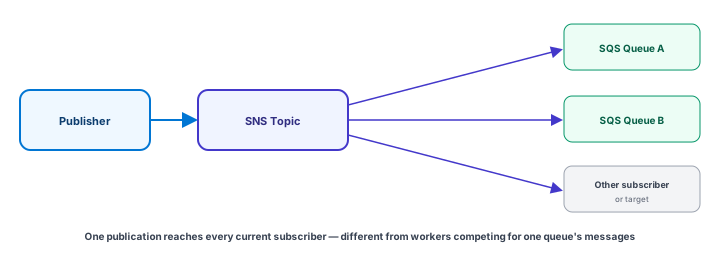
Fan-out: distributing one event to multiple independent processes
This pattern — one event, many interested parties — is called fan-out. Consider an order being completed: billing needs to know about it, analytics needs to know about it, and a notification might need to be sent — three genuinely different, independent pieces of processing, all triggered by the same single event. SNS's publish/subscribe model fits this exactly: publish the event once, and each subscriber does its own thing without knowing or caring what the others are doing.
SNS + SQS: fan-out with buffering per consumer
A very common, useful pattern combines SNS with SQS: publish an event to an SNS topic, and have that topic fan out to multiple SQS queues — one per consumer — rather than the consumers subscribing directly.
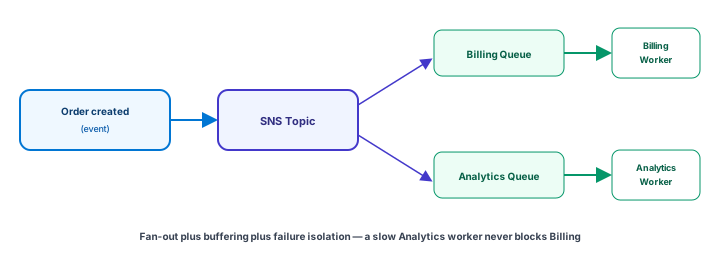
Why bother with a queue per subscriber instead of subscribing directly? Each queue gives its consumer the same buffering benefit Lesson 2 described for SQS generally — if the Billing worker is briefly overloaded, its messages simply wait in the Billing queue, with zero effect on the Analytics side. Subscribing a worker directly to SNS without a queue in between loses that buffering.
Not every subscriber type behaves identically
SNS can deliver to more than just SQS queues — Lambda functions and other subscriber types exist too, and this lesson doesn't try to enumerate every one or claim they all behave identically. The concept that matters at a beginner level is the shape (one publish, many subscribers, each independent), not memorizing every subscription type SNS supports.
Exercise
An order-completed event needs to independently reach a Billing process and an Analytics process, and each should be able to buffer its own work if temporarily busy. Using this lesson's pattern, describe the architecture you'd use (naming the specific AWS services involved), and explain why subscribing the Billing and Analytics workers directly to an SNS topic (with no queue in between) would lose an important property this scenario needs.
Show hint
The architecture is SNS fanning out to two separate SQS queues; the property lost without a queue is buffering.
Amazon SNS: Pub/Sub Messaging Quiz
My Notes
Log in to keep private notes on this lesson.
Questions about this lesson
No questions yet — be the first to ask.
Log in to ask a question about this lesson.
Summary
Amazon SNS distributes one published message to every current subscriber of a topic — fundamentally different from SQS, where multiple consumers of the same queue generally compete for its messages rather than each receiving a copy — and combining SNS with several independent SQS queues is a common pattern for fanning a single event out to multiple consumers that should each process it on their own schedule.