The AWS Well-Architected Framework
By the end of this lesson, you'll be able to:
- Explain the purpose of the AWS Well-Architected Framework as a set of review lenses, not a checklist to memorize
- Name the areas the framework asks an architecture to be reviewed against, at a conceptual level
- Apply the framework's questions to review a described architecture's trade-offs
Prerequisites: "Caching Strategies on AWS"
A framework for asking better questions, not memorizing answers
The AWS Well-Architected Framework is AWS's own structured approach to reviewing an architecture — not a single "correct" design, but a set of lenses to examine any given design through. AWS groups these lenses conceptually around areas including operational excellence (running and monitoring systems to deliver business value, and continuously improving), security (protecting data, systems, and assets), reliability (the ability to recover from disruption and meet demand), performance efficiency (using resources efficiently as demand and technology evolve), cost optimization (avoiding unnecessary spend), and sustainability (minimizing the environmental impact of running workloads).
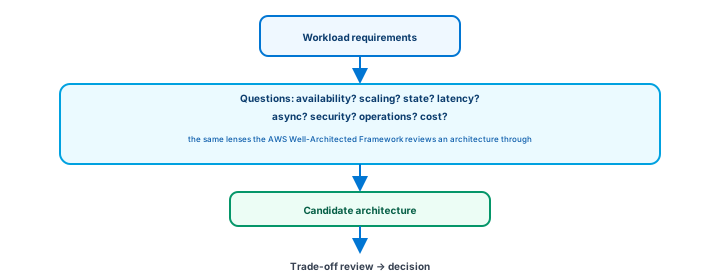
This lesson deliberately treats these as conceptual review areas, not a memorization target or a certification syllabus — the practical value is in the discipline of asking "have we actually considered this?" across every one of them for a real design, not in reciting their exact names.
Using the framework as questions, applied to this course's own patterns
Applied practically, each area becomes a question this course has already built the vocabulary to answer: Reliability — does the design assume components can fail, and does it recover (Lessons 1–2)? Performance efficiency — is compute and data access matched to the actual workload, including caching where it genuinely helps (Lesson 4)? Cost optimization — does resilience or performance spending match the actual requirement, rather than being added reflexively (next lesson)? Security — are IAM, network boundaries, encryption, and secrets handled the way Modules 2, 6, and 10 taught? Operational excellence — can the team actually observe what's happening (Module 10) and manage change safely (Module 11)?
None of these areas stands alone — a design can score well on performance and poorly on cost, or well on reliability and poorly on operational simplicity. The framework's real value is surfacing those tensions deliberately, rather than optimizing for one area and discovering the cost elsewhere too late.
Exercise
A team proposes an architecture that is highly resilient (multi-AZ everywhere, aggressive redundancy) but has no monitoring or alerting configured at all, and no one has reviewed its IAM permissions since the project started. Using the Well-Architected Framework's areas as review questions, identify which areas this design is weak in, and explain why strength in one area (reliability) doesn't make up for weakness in the others.
Show hint
Match the gaps described (no monitoring, unreviewed IAM) to the specific framework areas this lesson introduced.
The AWS Well-Architected Framework Quiz
My Notes
Log in to keep private notes on this lesson.
Questions about this lesson
No questions yet — be the first to ask.
Log in to ask a question about this lesson.
Summary
The AWS Well-Architected Framework is a structured way of reviewing an architecture through several conceptual lenses — commonly grouped around operational excellence, security, reliability, performance efficiency, cost optimization, and sustainability — used as a set of questions to reason through trade-offs, not a certification checklist or a memorized list of "correct" answers.