Caching Strategies on AWS
By the end of this lesson, you'll be able to:
- Explain what a cache is for and why it can reduce repeated, expensive work
- Explain cache invalidation and why stale cached data is a real design concern
- Identify a scenario where caching genuinely helps versus one where it adds risk without benefit
Prerequisites: "Auto Scaling Groups"
What a cache actually buys you
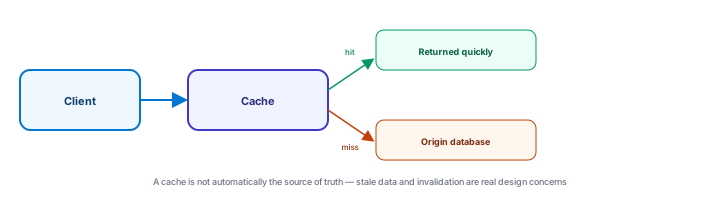
A cache stores frequently or recently needed data somewhere faster or closer to where it's consumed, so that a request can be answered from the cache instead of repeating expensive work against the origin — a database query, a slow computation, an external API call. This can meaningfully reduce load on the origin and improve response time for the requests it actually serves.
Invalidation: the genuinely hard part
The difficult part of caching isn't storing the value — it's knowing when a cached value is no longer accurate and needs to be refreshed or removed. If the origin data changes and the cache isn't updated or invalidated accordingly, requests served from the cache return stale data — technically fast, but wrong. This lesson doesn't walk through a specific invalidation implementation; the beginner-level habit to take away is recognizing that a cache is not automatically the source of truth, and any caching strategy has to explicitly account for how and when cached values get refreshed.
When caching genuinely helps — and when it doesn't
Caching fits well when the same data is requested repeatedly, is at least somewhat tolerant of being slightly out of date, and is genuinely expensive to regenerate each time. It fits poorly for data that must always be perfectly current (a real-time account balance, for instance) or that's rarely requested more than once anyway — in both cases, a cache adds real complexity (another place data can be wrong) without a proportional benefit. As with every architecture decision in this module, the right call depends on the actual requirement, not on caching being assumed to help everywhere.
Exercise
A team is deciding whether to cache two different values: (1) a list of published course titles, which changes rarely and is read on almost every page load, and (2) a user's current account balance, which must always reflect the very latest transaction. Using this lesson's reasoning, explain which one is a strong caching candidate and which one is not, and why applying caching to the wrong one would be a genuine risk rather than just a wasted optimization.
Show hint
Think about how often each value actually changes, and what happens if a request sees a stale version of each.
Caching Strategies on AWS Quiz
My Notes
Log in to keep private notes on this lesson.
Questions about this lesson
No questions yet — be the first to ask.
Log in to ask a question about this lesson.
Summary
A cache stores frequently or recently needed data closer to where it's consumed, reducing repeated, expensive work against an origin data source — but a cache is not automatically the source of truth, cache invalidation is a genuinely hard problem, and stale data is a real risk any caching strategy has to account for deliberately.