Securing the Application: IAM Roles and Policies
By the end of this lesson, you'll be able to:
- Apply least-privilege IAM roles to each Lambda function in this capstone's API layer, rather than one shared broad role
- Explain where secrets belong in this architecture, and where they must never appear
- Describe how encryption in transit and at rest, plus CloudTrail, contribute to this capstone's security posture
Prerequisites: "Designing the Data Layer: DynamoDB"
Security is designed in, not appended at the end
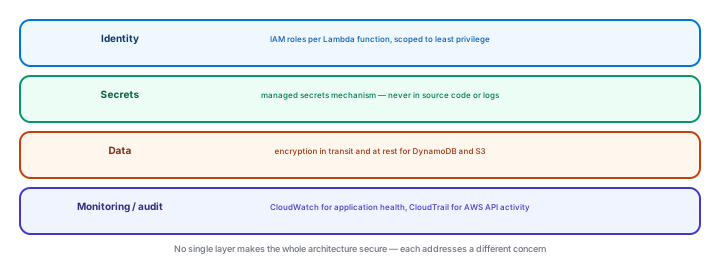
Module 2 introduced IAM and least privilege; Module 10 introduced monitoring and security together. This lesson applies both, specifically, to this capstone's architecture — across four layers that each answer a different question: who or what is allowed to act (identity), where sensitive values live (secrets), whether data can be read if intercepted or accessed directly (encryption), and whether changes can be traced after the fact (audit).
Least-privilege roles, one per function
Each Lambda function in this capstone's API layer gets its own IAM role, scoped to only the specific DynamoDB actions and specific table (or index) it actually needs — not one broad role shared across every function, and never a wildcard Action/Resource policy or an administrator-level role attached "to be safe."
Requirement: a compromised or buggy function should be able to do as little damage as possible. Decision: one IAM role per Lambda function, granting only the specific actions (for example, read-only access to the progress table for a "view progress" function, write access only for a "record progress" function) that function needs. Reason: this limits the blast radius of any single function's compromise or bug to exactly what that function was ever supposed to touch. Alternative: one shared, broadly-scoped role attached to every function for convenience. Trade-off: per-function roles mean more IAM resources to define and keep in the IaC template (Lesson 7) — a maintenance cost accepted in exchange for meaningfully reduced blast radius.
Secrets, encryption, and audit
No credentials or connection details for this application ever belong hardcoded in source code, in a Lambda's deployed code package, or written out to a log statement. Instead, they belong in a managed secrets mechanism that functions are granted permission to read at runtime — the credential itself never passes through source control or a code review.
Data protection here means two related things: encryption in transit (traffic between the learner's browser, CloudFront, API Gateway, and Lambda travels over HTTPS/TLS) and encryption at rest (data stored in DynamoDB and S3 is encrypted on disk). Neither substitutes for the other — a system can encrypt data at rest and still leak it in transit over an unencrypted connection, or vice versa.
Finally, CloudTrail records every AWS API call made against this application's resources — who created, modified, or deleted what, and when. This is the audit trail Lesson 6 draws on when investigating a change after the fact; it answers a different question from CloudWatch's application-health monitoring, covered next.
Exercise
A teammate proposes giving every Lambda function in this application the same IAM role, with full read/write access to every DynamoDB table, "so we don't have to keep managing separate roles." Write a short response explaining the security cost of this shortcut and what you would propose instead.
Show hint
Think in terms of blast radius: what could go wrong with one function's code or credentials under the shared-role approach that couldn't happen under per-function least-privilege roles?
Securing the Application: IAM Roles and Policies Quiz
My Notes
Log in to keep private notes on this lesson.
Questions about this lesson
No questions yet — be the first to ask.
Log in to ask a question about this lesson.
Summary
Security in this capstone is designed in from the start rather than appended at the end: each Lambda function gets its own IAM role scoped to only the DynamoDB actions and resources it actually needs, secrets are held in a managed secrets mechanism and never committed to source or written to logs, data is encrypted in transit and at rest, and CloudTrail records who or what changed any AWS resource.